
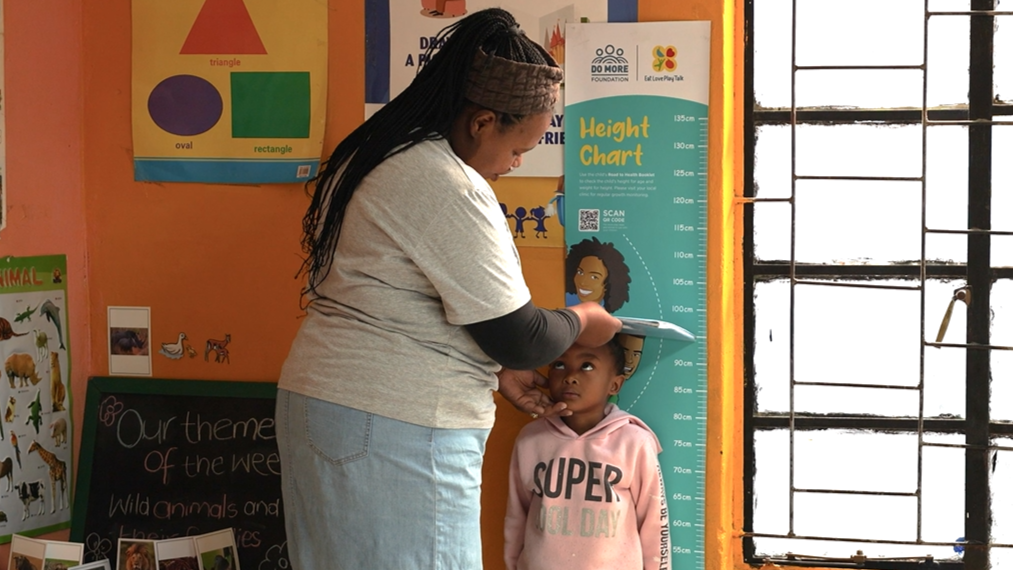
How nutrition monitoring across more than 100 ECD centres is helping strengthen support for young children.
Every child in South Africa has the constitutional right to adequate nutrition, yet many young children still face uncertainty when it comes to accessing enough healthy food. Nutrition in the early years is essential for children’s growth, development and readiness to learn. Over the past three years, Inceba Trust has equipped principals with tools and training to monitor children’s growth, strengthening nutrition awareness and enabling more targeted support where it is most needed.
The first five years of life are a critical period of development, yet nutrition challenges are not always immediately visible. Without regular monitoring, children who may need additional support can easily be overlooked. Recognising this, Inceba Trust began a pilot project in 2023, measuring the height and weight of 838 children aged five to 59 months. This expanded to 3927 children in 2024 and 4331 children in the 2025 baseline assessment. A follow-up assessment later that year included 2510 children, allowing progress to be tracked over time.
The nutrition monitoring currently includes more than 100 early childhood development centres in the Drakenstein and Stellenbosch municipal areas, as well as Worcester and Kimberley.
Principals were trained to conduct height and weight measurements accurately and were provided with scales, height charts and guidance. This process strengthened their ability to understand children’s growth and identify potential concerns early.
“Children who receive nutritious food every day can grow, learn and develop optimally. When we began measuring children’s growth, we saw that some children were not developing as expected. Measuring allowed us to better understand where support was needed and to work alongside early childhood development centres and partners to respond in practical ways,” says Nielen Bekker, CEO of Inceba Trust.
The baseline findings highlighted the importance of strengthening nutrition practices within the centres. In response, principals increased their focus on balanced menu planning, food preparation and monitoring children’s development. This has contributed to greater awareness among staff and more intentional daily practices.
Partnerships have also played an important role. Through collaboration with Outside the Bowl Africa, breakfast porridge was provided to selected centres where children were identified as being at greater nutritional risk. This support, made possible through donor funding, helped ensure that assistance reached children who needed it most.
For principals, this has made a meaningful difference in their ability to support the children in their care. Thandile Mbaqa, Principal, ABC Crèche, Kayamandi says: “We are very grateful for the nutritional programme. We are receiving breakfast porridge that supports the children’s growth and development. What I appreciate most is that we can monitor their progress and see their growth over time. It helps us understand how to better support the children.”
The follow-up assessment at the end of 2025 showed encouraging progress. The percentage of children showing signs of wasting declined from 4.9% to 3.6%, and underweight declined from 6.4% to 4.5%. Stunting also showed a slight improvement. At the same time, the findings highlighted areas that require continued attention, including an increase in the percentage of children showing signs of being overweight.
Beyond the data, one of the most significant outcomes has been the strengthening of capacity within centres. Principals are now better equipped to monitor children’s growth, recognise potential concerns and respond appropriately. This knowledge enables early childhood development centres to play an even stronger role in supporting children’s development.
The Western Cape Department of Health contributed to this work by providing training in anthropometry, ensuring that measurements were conducted accurately. Partnerships with organisations such as Outside the Bowl Africa have further strengthened the support available to centres and the children they serve, by providing VitaKidz instant energy meals to centres where children have been identified as being at risk of malnutrition.
Early childhood development centres are uniquely positioned to observe children regularly and support their development during these formative years. By equipping principals with practical tools and strengthening partnerships, it becomes possible to respond more effectively to children’s nutritional needs.
“While nutrition challenges cannot be resolved overnight, consistent monitoring, strengthened practices and collaboration are helping to build a stronger foundation. These efforts contribute to creating environments where young children are better supported to grow, develop and enter formal schooling ready to learn and thrive,” says Nielen.
Want to find out more? Contact Inceba Trust at media@incebatrust.co.za.